



Data is by far the most valuable asset any company or individual can hold in today’s world. Businesses, governments, and societies must use, store, and preserve data correctly. This is what makes Cloud so essential! Different countries and industries use data centres and cloud infrastructures to automate and optimize processes. Even developing countries are implementing cloud adoption frameworks to stay competitive in the market.
The public cloud is now being adopted by global businesses and organizations due to its ability to deliver IT cost efficiencies and support startup businesses. The potential benefits are enormous in the Middle East, which is why businesses are slowly becoming more open towards cloud adoption. As per McKinsey research, the cloud holds potential to generate value of over $183 billion by 2030, which would be approximately 6% of the region’s GDP. However, businesses still face numerous challenges in cloud adoption. Join us as we explore the cloud revolution in the Middle East, discussing how to overcome challenges and seize opportunities.
Cloud Computing In The Middle East: A Basic Overview
In the sprawling, innovative landscapes of the Middle East, a profound transformation is underway. Cloud Computing, once a futuristic concept, is now a fundamental pillar of modern enterprise, promising agility, scalability, and unprecedented efficiency. Yet, just like any other major endeavour, its adoption journey in this unique region comes with its own set of fascinating challenges and equally innovative solutions.
So let’s peel off the layers and understand the meaning of cloud computing, its immense importance, pinpoint the specific hurdles in the Middle East, and how they tackle them.
What Is Cloud Computing and Why Is It Essential?
At its core, “cloud computing” means delivery of computing services—including servers, storage, databases, networking, software, analytics, and intelligence—over the Internet (“the cloud”). Instead of owning your computing infrastructure or data centres, you can access these services from a cloud provider (like AWS, Azure, Google Cloud) and pay-as-you-go, much like a utility bill. This model fundamentally shifts IT from a capital expenditure (buying hardware) to an operational expenditure (paying for usage).
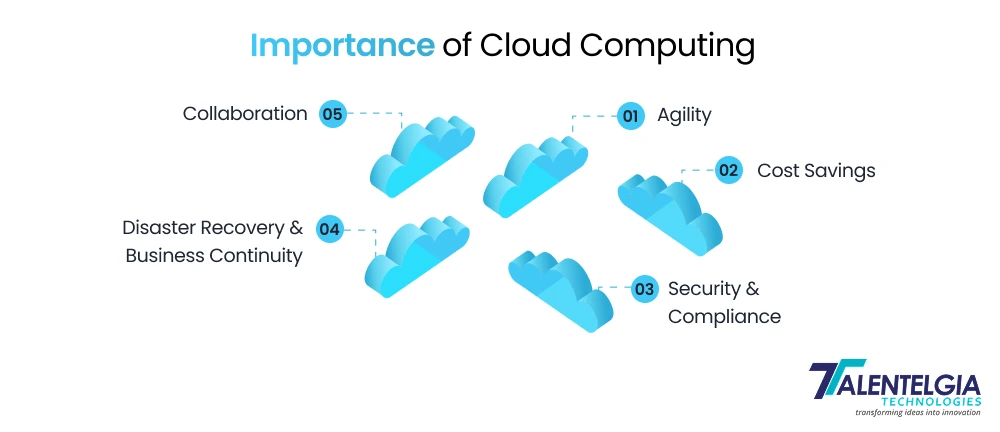
It’s about having your IT infrastructure available on demand, anywhere, anytime, scaling up or down with your needs, without the burden of physical maintenance or upfront investment. That’s why the importance of cloud computing extends far beyond just cost savings. It’s genuinely an engine driving business innovation and resilience:
- Agility: Quickly launch new apps, scale resources, and innovate with less friction.
- Cost Savings: No need for costly on-premise hardware or massive IT teams.
- Security & Compliance: Benefit from the robust security investments of global providers.
- Disaster Recovery & Business Continuity: Rapid backup, replication, and recovery in the face of disruption.
- Collaboration: Seamless remote work and cross-border teamwork.
Challenges of Cloud Adoption In The Middle East
Startups and organizations all over the world have begun to leverage cloud services, from operational efficiency to optimizing business processes in ways never thought possible. Almost every possible operation can be conducted via cloud— store massive amounts of data, simplify communication among employees, improve disaster recovery readiness— in all these cases, cloud is the answer.
As the Middle East region seeks to leverage the cloud fully, it is confronted with a number of obstacles and issues. Let’s discuss some of them.
1. Data Sovereignty & Local Regulations
This is arguably the biggest hurdle. Many Middle Eastern countries have stringent data residency laws, dictating that certain types of data (especially government, financial, or personal data) must remain within national borders. The limited availability of local cloud regions from global providers can make compliance complex and expensive.
Solution: Global cloud providers are increasingly investing in data centres within Middle Eastern countries (like AWS, Microsoft, and Google), and rising regional cloud providers make it easier to keep data local. Hybrid cloud setups—storing sensitive data on-premises and using the public cloud for everything else—are also gaining traction.
2. Cybersecurity & Trust Concerns
Despite the robust security offerings of major cloud providers, there can be lingering skepticism or a lack of trust among some organizations, particularly in sensitive sectors, about moving data off-premises. The region is also a frequent target for cyberattacks, heightening security anxieties.
Solution: Select cloud partners with certifications that match (or exceed) local security standards. Invest in encryption, robust user access controls, and regular audits. Some businesses also work with trusted, local managed service providers to bridge cultural and technical gaps.
3. Legacy Infrastructure & Skill Shortages
Many established organizations in the Middle East operate on deeply entrenched, often monolithic, legacy IT systems. Migrating these to the cloud can be a daunting, complex, and time-consuming process, fraught with compatibility issues.
Solution: Move in phases—start with less critical systems to gain internal expertise and confidence. Instead of a “big bang” approach, organizations adopt phased migrations (“lift and shift” for non-critical apps, followed by refactoring) or opt for application modernization to cloud-native architectures, making the transition smoother.
4. Bandwidth & Connectivity Issues
While major urban centers boast excellent infrastructure, some remote or developing areas within the wider Middle East might still face bandwidth limitations or unreliable internet connectivity, which are critical for cloud services.
Solution: Governments and Telecom companies are rushing to expand high-speed networks (Optical Fibre, 5G), while edge computing models—processing critical data closer to the source—reduce reliance on cloud latencies.
5. Talent Gap & Skill Shortage
A significant challenge is the scarcity of local IT professionals with advanced cloud skills (architecture, security, DevOps, migration). This often necessitates relying on external consultants or lengthy retraining programs.
Solution: Governments and private sector entities are investing heavily in national initiatives, training programs, and certifications to nurture local cloud talent. Attracting international expertise also plays a role in bridging the gap.
Real-Word Case Study Examples: Cloud Success Stories In the Middle East
The Middle East is already home to numerous cloud success stories. With the relentless pursuit of growth, innovative methods such as the adoption of cloud technology have been embraced across various industries. Here are a few real-life case studies of cloud adoption across specific business sectors that have noticeably helped Middle Eastern nations:
Case Study 1: Emirates NBD — Digital Banking Breakthrough
Context: As one of the largest banking groups in the Middle East, Emirates NBD embarked on a significant digital transformation journey to enhance its competitive edge and service offerings. They sought the agility and efficiency of cloud-native stacks while adhering to strict regulatory constraints.
When Emirates NBD launched its digital-only banking arm, Liv., it needed speed and regulatory compliance. By adopting a hybrid cloud approach—storing sensitive data locally, but harnessing the public cloud for rapid innovation—they accelerated new feature rollouts while staying fully compliant.
Result:
- Reduced time-to-innovation from months to days
- Enhanced digital banking capabilities
- Achieved 42% better performance and 20% fewer virtualization software licenses.
Case Study 2: Saudi Ministry of Health — Rapid Responses to COVID-19
Context: Aligning with Saudi Vision 2030, the Ministry of Health aimed to modernize healthcare systems, improve efficiency, and enable healthcare professionals to innovate, especially critical during the COVID-19 pandemic. They faced challenges related to data privacy, control, and the need for scalable infrastructure across a large geographical area.
During the pandemic, the Saudi Ministry of Health rapidly migrated critical applications to the Cloud, enabling real-time dashboards, telemedicine, and online appointment systems for millions.
Result:
- Enhanced monitoring of vaccination campaigns
- Improved remote access to patient records
- Increased operational efficiencies and resilience across the healthcare system.
Case Study 3: Qatar Airways — Smarter Skies
Context: As a world-leading airline, Qatar Airways is committed to delivering superior customer experiences, optimizing operations, and maintaining its position at the forefront of aviation. They needed to leverage their vast amount of structured and unstructured data to provide personalized offerings and enhance operational efficiencies, while ensuring data residency compliance.
Qatar Airways leveraged cloud solutions to personalize passenger experiences and optimize aircraft maintenance, integrating data from multiple sources into a single, cloud-based platform.
Result:
- Highly personalised traveller journeys
- Predictive maintenance reduced downtime
- Agility in responding to operational issues
Final Thought
The Middle East’s embrace of the cloud is unlocking digital potential across every sector. The next chapter will be even brighter—full of new possibilities for growth, resilience, and creativity. Organizations that stay agile and embrace these changes today will lead the way in tomorrow’s digital world.
For more information on cloud services, contact our expert team today!












 Business:
+971 565-096-650
Business:
+971 565-096-650
 Write us on:
  Business queries:
  HR:
HR: 


